The Innovation Fund's EUR 3.4 Billion Net-Zero Call: 77 Projects Selected and a New Round Coming in December
The European Commission has selected 77 net-zero technology projects to share EUR 3.4 billion under the Innovation Fund's 2025 call. The next round of calls opens in early December 2026 with a EUR 1 billion clean tech manufacturing topic.
On 19 October 2026, the European Commission announced the results of the Innovation Fund's 2025 net-zero technologies call (IF25), launched in December 2025: 77 projects across 23 EEA countries will share EUR 3.4 billion in grants, financed by revenues from the EU Emissions Trading System. It is one of the largest single funding decisions for clean technologies ever made in Europe, and the next round of calls is already scheduled for early December 2026.
A sixfold oversubscribed call
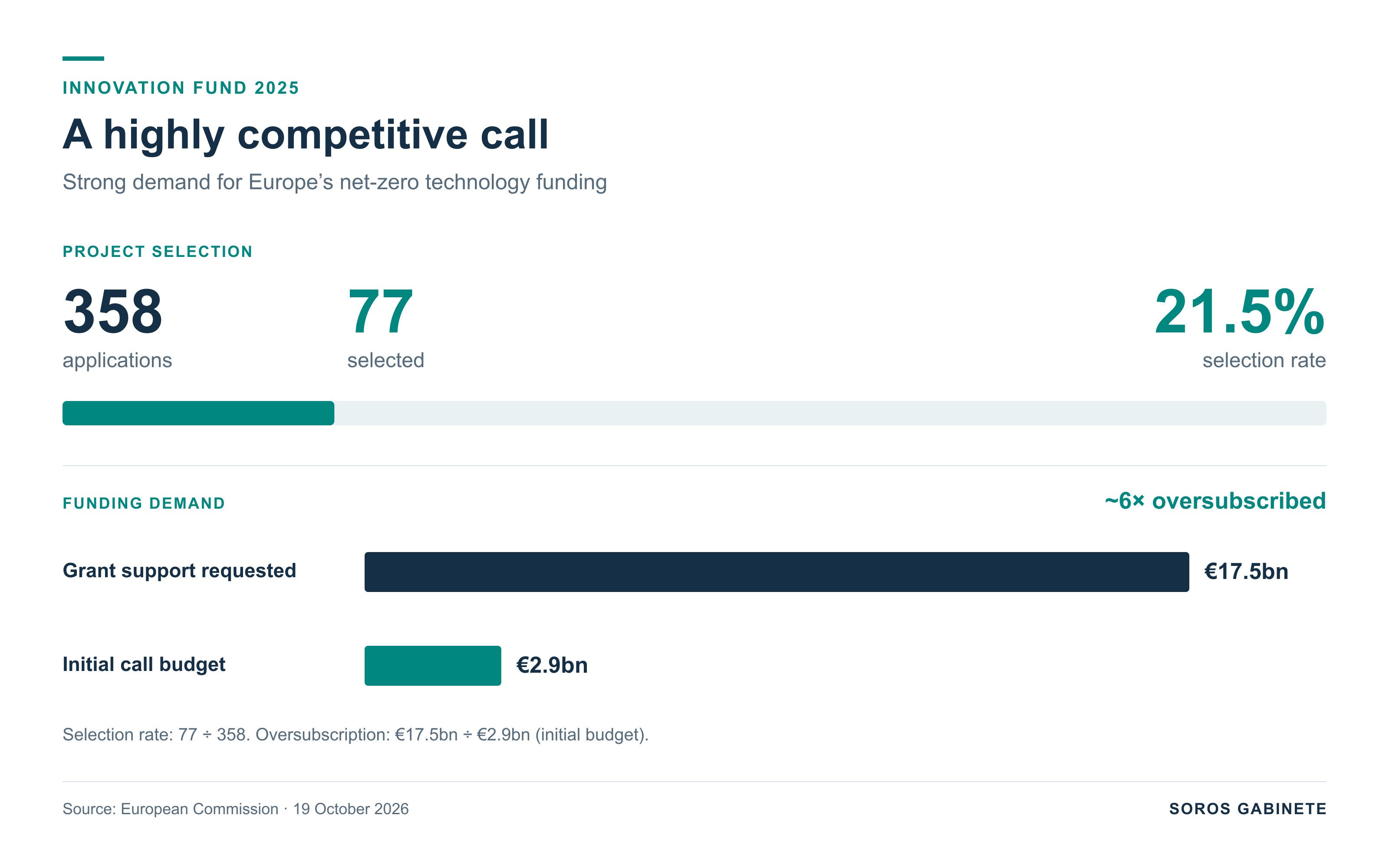
The demand side of the call is as significant as the awards themselves:
358 applications were submitted, requesting a combined EUR 17.5 billion against an available budget of EUR 2.9 billion.
The 77 selected projects imply a selection rate of roughly 21.5%.
All five topics of the call were oversubscribed, which the Commission reads as evidence of the maturity of Europe's net-zero technology sector.
For applicants, the message is clear: this is a highly competitive instrument where technical preparation and project maturity decide. Awards are scored by independent experts on greenhouse gas reduction potential, degree of innovation, maturity, replicability and cost efficiency.
What was funded
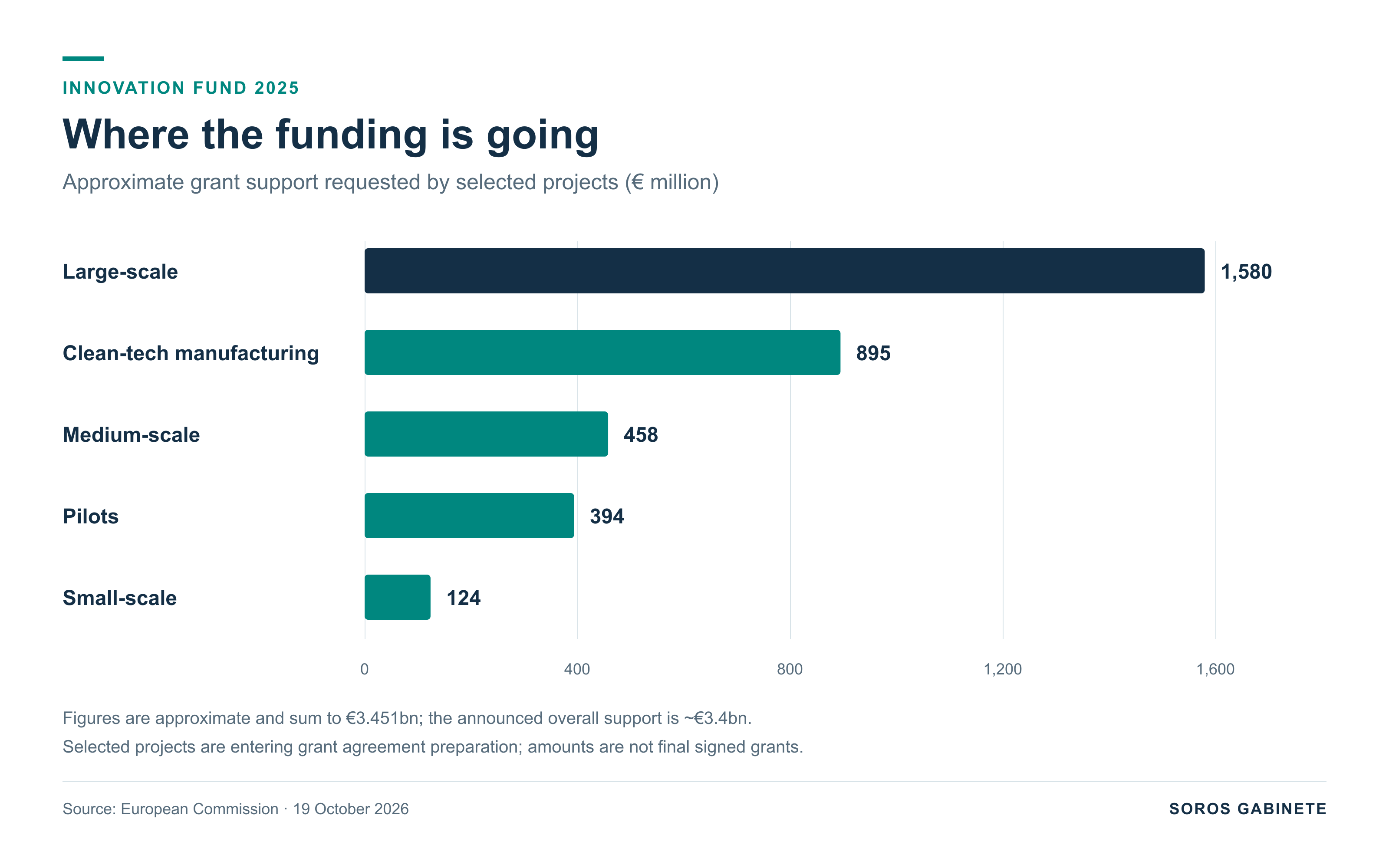
The 77 projects spread across five topics:
Large-scale decarbonisation: 12 projects, around EUR 1.58 billion requested (advanced fuels, industrial carbon management, chemicals, iron and steel, aviation).
Medium-scale: 17 projects, around EUR 458 million (chemicals, refineries, maritime, storage, cement, hydrogen).
Small-scale: 20 projects, around EUR 124 million, the most accessible entry point for smaller companies (critical raw materials recycling, pulp and paper, ocean energy, buildings).
Clean-tech manufacturing: 12 projects, almost EUR 895 million (heat pumps, solar panels, electrolysers, EV batteries, rare earth magnets).
Pilots: 16 projects, around EUR 394 million.
Two firsts stand out: the portfolio includes the first small modular nuclear reactor project and the first direct air carbon capture and storage (DACCS) project ever funded by the Innovation Fund. It also includes 6 critical raw materials projects aligned with the Net-Zero Industry Act and the RESourceEU Action Plan. The Commission estimates the 77 projects will avoid around 290 million tonnes of CO2 over their first decade, roughly one tonne per second for ten years.
Considering an application? Our Innovation Fund application guide explains eligibility, funding rates, project categories and how to prepare.
STEP seal and Project Development Assistance: the value of applying, even without a grant
The call also generated value beyond the 77 grants:
84 additional projects passed the evaluation but could not be funded within budget. Together with the 77 selected, they receive the STEP seal, a quality label designed to ease access to other public and private funding.
160 further proposals remain eligible for Project Development Assistance (PDA), technical and financial advisory support from the European Investment Bank to bring projects to bankability.
What comes next
Grant agreement preparation with CINEA starts now, with final results expected in the first quarter of 2027. More relevant for future applicants: the Commission will launch the next round of Innovation Fund calls in early December 2026, including a EUR 1 billion topic dedicated to clean tech manufacturing, aimed at de-risking supply chains under the RESourceEU Action Plan. The Fund's full portfolio now stands at around 320 projects with almost EUR 17 billion committed, backed by an estimated EUR 40 billion in ETS revenues over 2020-2030.
Our reading
The IF25 results illustrate a structural challenge in European clean-tech funding: the availability of substantial public resources does not necessarily translate into easy access to grants. With demand exceeding the initial budget by a factor of six, project selection is increasingly demanding.
For prospective applicants, three considerations stand out.
First, project maturity matters as much as technological ambition. The Innovation Fund is designed to support the deployment of innovative technologies at industrial scale. A compelling technology must be accompanied by credible implementation plans, robust financial assumptions, measurable emissions reductions and a convincing business case.
Second, choosing the right funding instrument is a strategic decision. Not every promising clean-tech project is ready for the Innovation Fund. Companies should assess whether their technology, investment scale and development stage genuinely match the programme's objectives before committing resources to an application.
Third, an unsuccessful application does not necessarily mean the end of the funding journey. The STEP Seal and Project Development Assistance can provide additional opportunities for high-quality proposals, although neither guarantees subsequent financing.
With new calls expected in December 2026, including €1 billion dedicated to clean-tech manufacturing, companies considering an application should begin assessing their eligibility, project maturity and funding strategy now.
Need help with your funding application?
Our team of experts is ready to help you secure funding for your innovation project.
Contact Us