Innovation Fund: Eligibility, Funding and How to Apply
Explore EU Innovation Fund eligibility, grant rates, project categories and application requirements, plus upcoming opportunities for clean technology projects.

Last updated: 5 November 2026
The EU Innovation Fund supports companies bringing innovative net-zero technologies to market. For project developers, the key questions are whether the project fits an eligible topic, how much support it could receive and whether it is mature enough to submit a competitive application.
This guide focuses on regular grants, using the 2025 Net-Zero Technologies call (IF25 NZT) as a reference and highlighting upcoming opportunities.
What is the Innovation Fund?
The Innovation Fund is one of the world’s largest programmes supporting the deployment of innovative net-zero technologies. It is financed through the EU Emissions Trading System, with funding estimated at around €40 billion for 2020–2030, depending on carbon prices.
Its scope includes energy-intensive industries, renewable energy, energy storage, industrial carbon management, and net-zero mobility and buildings. It also supports clean technology manufacturing. Funding is awarded through regular grant calls and separate competitive auctions, which have different rules. European Commission: Innovation Fund overview.
Who can apply?
Companies should distinguish between the location of the applicant and the location of the project. Under IF25, applicants could be based outside the European Economic Area, subject to the call’s restrictions, while the project itself had to be located in an EEA country.
Applicants also needed to demonstrate a credible route to financial close within four years of grant signature. Eligibility alone is therefore only the starting point: the financing and implementation plan must be convincing. CINEA: IF25 Questions & Answers.
For a company assessing an application, three questions should come first:
Does the proposed activity fit the selected topic?
Is there evidence that the technology offers a meaningful improvement over existing solutions?
Can the project demonstrate a realistic delivery and financing plan?
Which projects are eligible?
The topic determines both the eligible activities and the project size. The following table summarises the IF25 structure as a reference for planning.
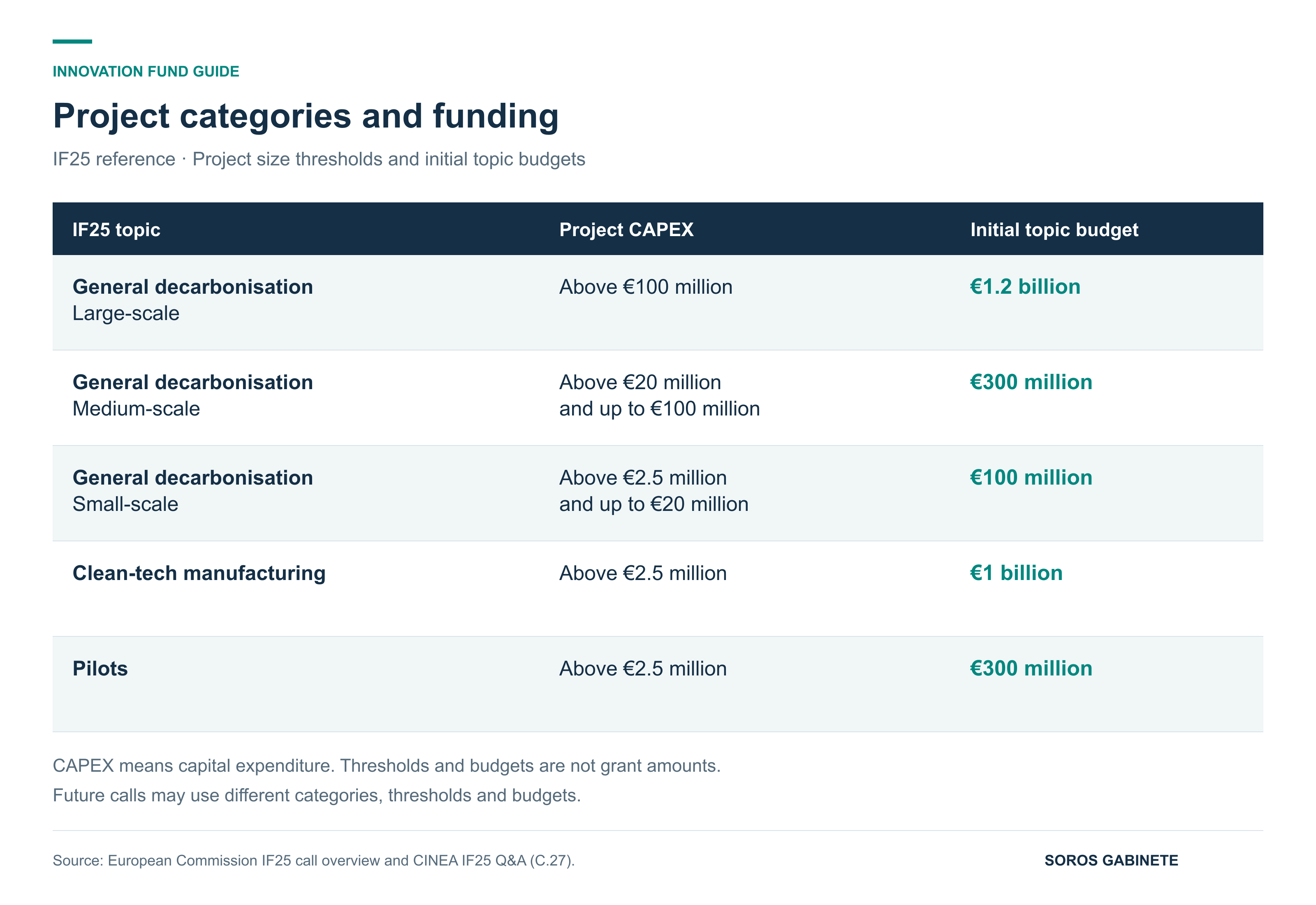
These are project CAPEX thresholds and initial call budgets, rather than minimum or maximum grant amounts. Meeting a size threshold does not establish eligibility: the project must also satisfy the topic’s technical scope and conditions. Future calls may change this structure. European Commission: IF25 call overview and CINEA: detailed CAPEX thresholds, question C.27.
How much funding can a project receive?
Regular grants can cover up to 60% of the project’s relevant costs, calculated using the methodology applicable to the call. This does not automatically mean 60% of total project investment.
Payments depend on project milestones. Up to 40% of the grant can be paid against predefined milestones before the whole project is fully operational. Applicants should therefore plan both the remaining financing and the cash flow needed between payments. CINEA: financing rates and payment principles.
The support is a grant rather than a loan, but beneficiaries must fulfil the grant agreement. Under IF25, payments take the form of lump sums linked to milestones and completed work packages. Failure to meet the applicable obligations or emissions avoidance requirements can lead to grant reductions or recovery. CINEA: IF25 payment conditions, section E.
How does the application process work?
IF25 used a single-stage application process through the EU Funding & Tenders Portal. Preparation involved several connected elements:
Application forms describing the project and its expected results.
A greenhouse gas emissions avoidance calculation.
A business plan and financial information.
A delivery schedule with work packages and milestones.
Supporting evidence addressing the call’s technical and environmental requirements.
CINEA provides tutorials on the application procedure, Part C, the Financial Information File, business planning and greenhouse gas calculations. Its call page also links to the official templates, self-check questionnaire and helpdesk. CINEA: IF25 application resources.
A practical way to organise preparation is to test the project’s topic fit first, then develop the technical, financial and emissions evidence together. The application should present one consistent project: capacity, costs, timetable, revenues and emissions assumptions need to agree across the documents.
What do evaluators look for?
For IF25, independent experts assessed proposals against five main criteria:
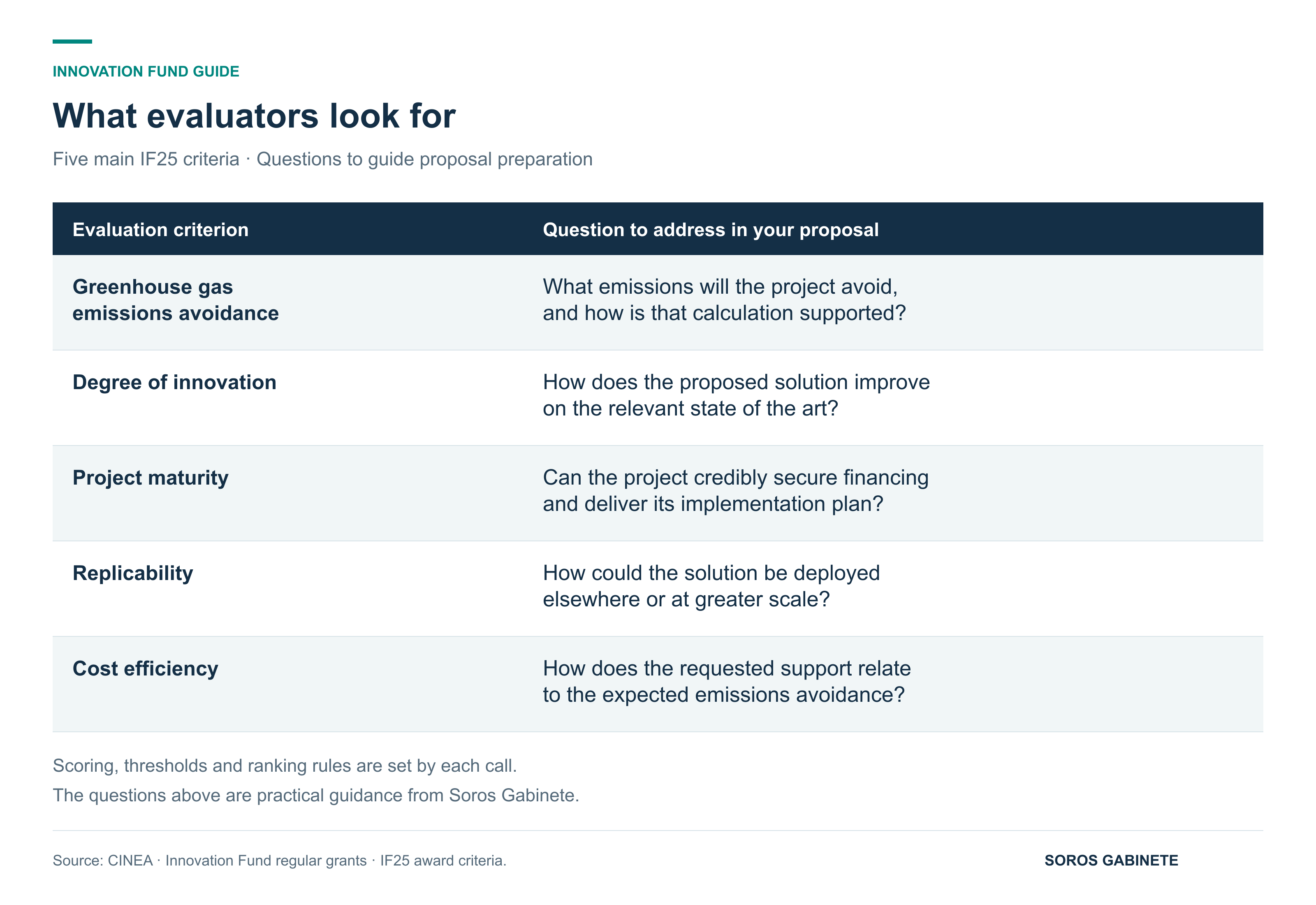
The exact scoring, thresholds and ranking rules are set by each call. CINEA: award criteria.
How competitive is the Innovation Fund?
IF25 attracted 358 applications requesting €17.5 billion, compared with an initial budget of €2.9 billion: approximately six times the available funding.
The Commission selected 77 projects, equivalent to a selection rate of approximately 21.5%, and announced around €3.4 billion in support. The initial budget and the subsequently announced support are different figures.
Selection also precedes final grant agreement preparation. For IF25, the Commission expected the results of that preparation process in the first quarter of 2027. European Commission: IF25 results, 19 October 2026.
What happens if a project is not selected?
Some proposals can benefit from support beyond a grant award. In IF25, 84 additional projects passed evaluation without receiving funding and were set to receive the STEP Seal alongside the selected projects. A further 160 proposals remained eligible for European Investment Bank Project Development Assistance.
Neither a quality label nor eligibility for advisory support should be treated as a funding commitment. European Commission: IF25 evaluation outcomes.
Upcoming Innovation Fund calls
As of 5 November 2026, the Commission is preparing the next round of calls for early December 2026, including a €1 billion clean-tech manufacturing topic. European Commission: next steps.
A dedicated IF26 SME call is also planned, with a proposed budget of €200 million for projects with CAPEX between €2.5 million and €20 million. The announced design includes simpler application requirements and two application rounds. If applying as a consortium, all members must be SMEs.
Publication is expected in December 2026, with indicative deadlines at the end of March and September 2027. The final call documents will establish the applicable conditions and dates. European Commission: IF26 SME call.
Frequently asked questions
Can an SME apply to the Innovation Fund?
SMEs should assess both the relevant regular grant topics and the planned dedicated IF26 SME call. Project size, scope and maturity matter, and the dedicated call will have its own conditions. IF26 SME call information.
Does the grant cover 60% of total investment?
The funding rate applies to relevant costs calculated under the call methodology. A project should establish that calculation before estimating its potential grant. CINEA: funding rates.
Can an unsuccessful applicant apply again?
Yes. Applicants can submit to future Innovation Fund calls, using the forms and conditions applicable to the new round. CINEA: IF25 Questions & Answers, questions A.11 and A.14.
Can the grant be combined with other funding?
Innovation Fund regular grants can be combined with other funding sources. The financing structure must respect the applicable combination rules, including State aid limits where relevant. European Commission: other funding and State aid.
Assess your project’s fit with Soros Gabinete
At Soros Gabinete, we support companies throughout the European innovation funding application cycle, from topic fit and maturity assessment to technical and financial documentation.
If you are considering an Innovation Fund application, contact us for an initial assessment of your project’s fit, readiness and documentation needs. This helps identify the most suitable opportunity and the preparation required before submission.
For a closer look at the selected projects and funding by topic, read our analysis of the Innovation Fund’s 2025 call results.
Need help with your funding application?
Our team of experts is ready to help you secure funding for your innovation project.
Contact Us