How Can Factory Automation Make Remanufacturing an Industrial Business?
A €36 million Horizon Europe topic supports factory technologies for disassembly, repair and remanufacturing. What industrial users and technology providers should prepare before the 2027 deadline.
How Can Factory Automation Make Remanufacturing an Industrial Business?
Europe's circular economy needs factories that can recover a product's function, not only its materials. A forthcoming €36 million Horizon Europe topic supports technologies for disassembly, repair and remanufacturing, combining industrial automation with a credible route to adoption.
Why is this a factory problem?
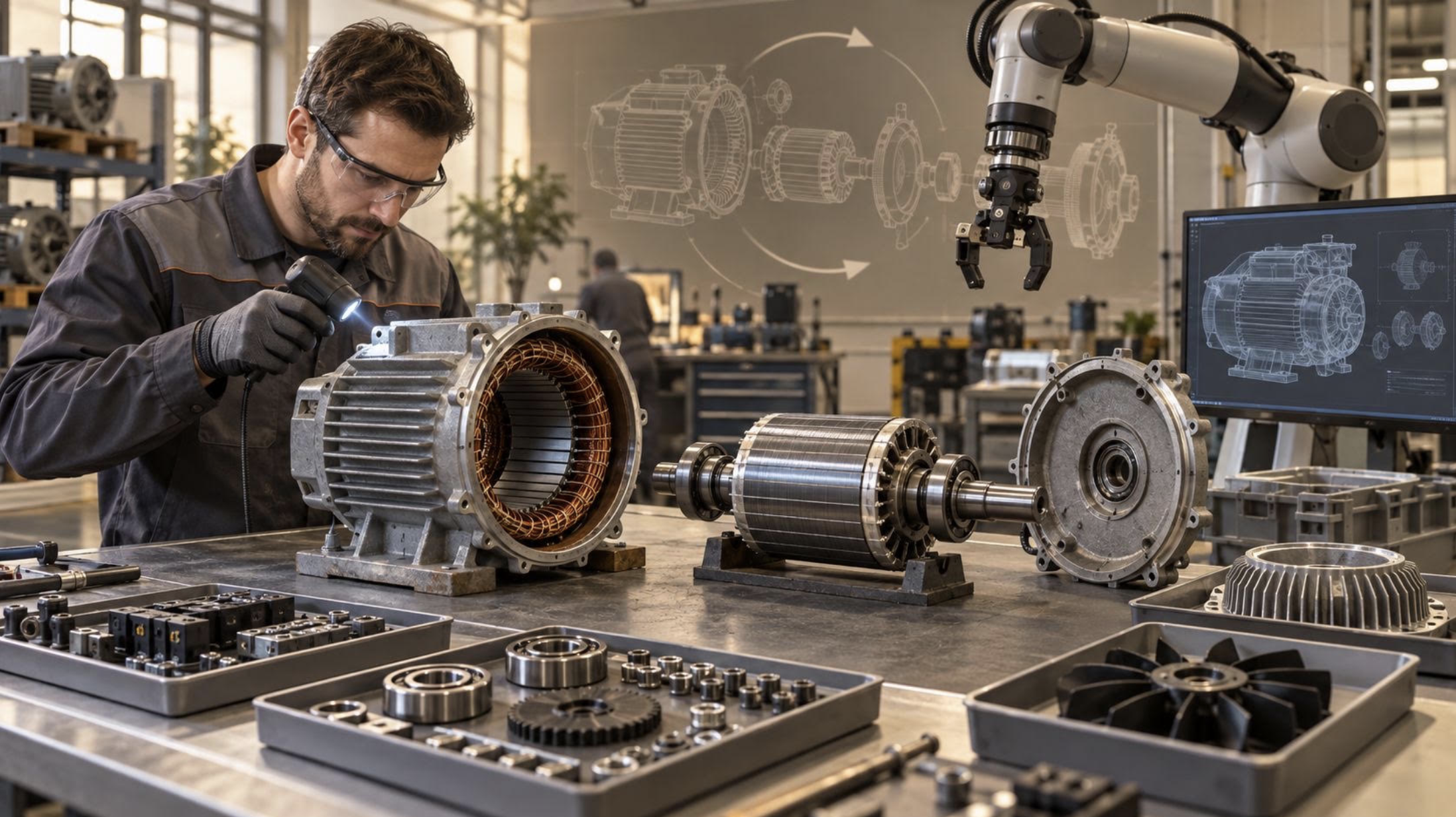
A used component does not arrive with the predictable condition of a new one. Its wear, geometry, remaining value and repair needs may differ from the next component on the line. That makes inspection, handling and process planning central to whether remanufacturing can work at industrial scale.
The Horizon Europe topic HORIZON-CL4-2027-01-MAT-PROD-03, under the Made in Europe partnership, addresses this factory-level challenge. Its intended outcomes include retaining, reusing, upgrading or adapting product functions, developing remanufacturing technologies, and improving relevant skills, standards and safety measures.
What does the funding cover?
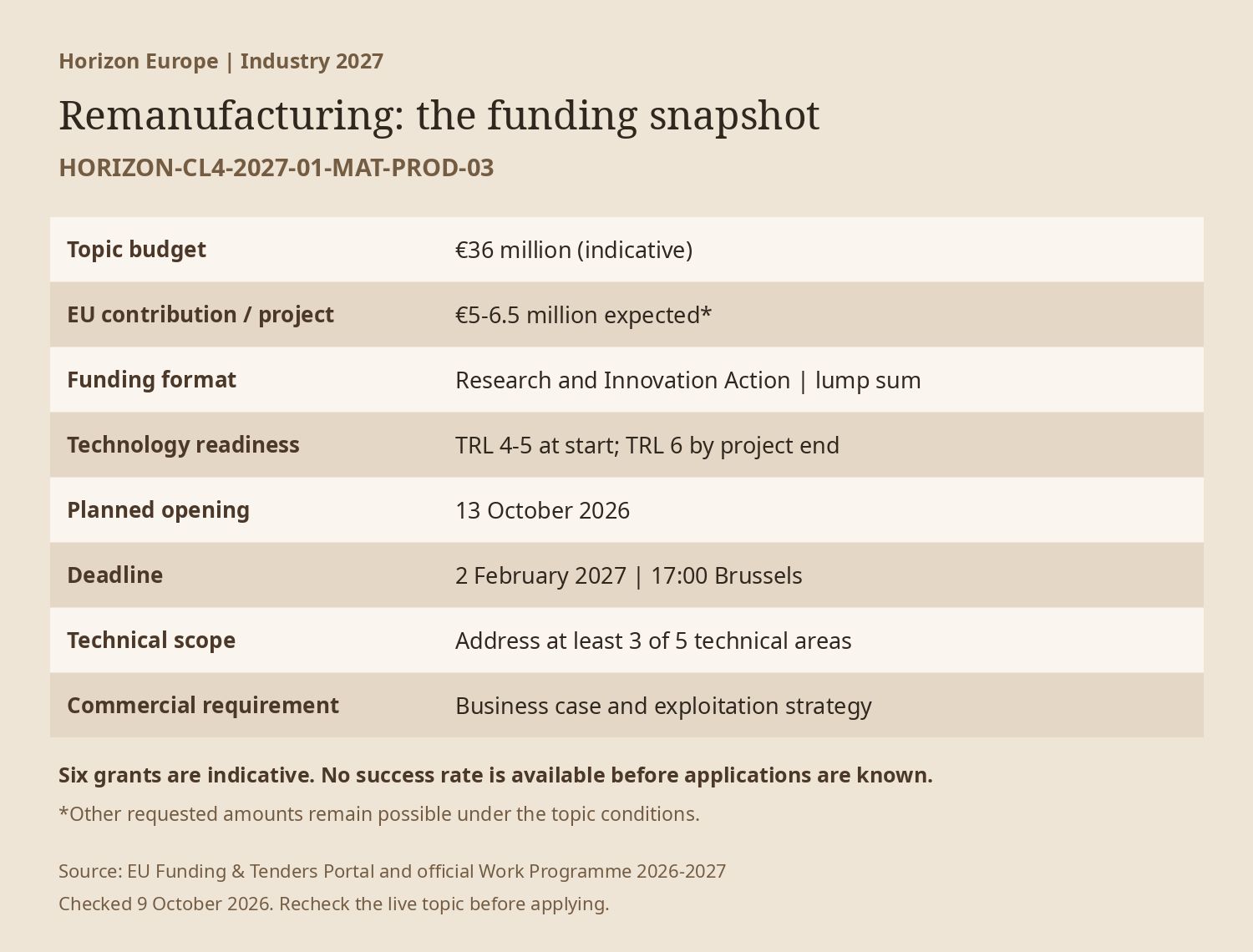
The topic has an indicative €36 million budget. The Commission expects contributions of €5 million to €6.5 million per project, while allowing proposals requesting different amounts. The call overview indicates six projects may be funded. That is a planning figure, not a selection rate: the number of applications is not yet known.
The portal currently lists the topic as forthcoming, with planned opening on 13 October 2026 and a single-stage deadline of 2 February 2027 at 17:00 Brussels time. It is a Research and Innovation Action using lump-sum funding. Activities are expected to start at technology readiness levels 4-5 and reach level 6, rather than begin with a finished commercial production line.
Which technologies need to work together?
Proposals must address at least three of five areas:
Part-condition analysis and predictive maintenance, including multimodal sensor data, AI and human input.
AI and robotic-assisted disassembly, including handling, sorting and logistics.
Model-based systems that use original CAD data and digital twins.
On-site repair or remanufacturing of high-value components, for example in wind turbines, aircraft or vessels.
Planning the sequence of operations around the condition of incoming products.
A standalone inspection algorithm or robotic gripper is therefore unlikely to answer the whole topic. The practical opportunity is to connect technologies around a defined product family and an industrial workflow, with clear evidence of how each contribution helps retain value.
Why does the business case matter?
The topic explicitly requires a business case and exploitation strategy. These should consider adoption, product and component value, links between manufacturing and remanufacturing plants, and risks arising from variable incoming flows.
For a manufacturer, the starting question is which products have recoverable value and a plausible route back into use. For an automation or software provider, it is which bottleneck the technology removes and who will operate the combined system. Safety, workforce skills and standards belong in that design, not only in a final impact paragraph.
Who should prepare now?
The normal Horizon Europe consortium minimum applies unless specific conditions provide otherwise: three independent legal entities in three different countries, including one in an EU Member State and two others in different Member States or Associated Countries. Applicants must also check funding eligibility and participation restrictions; entities established in China are excluded from RIAs under this destination.
An effective preparation process connects industrial users, technology developers and research partners before drafting. The funding opportunity is to test a workable remanufacturing system and its business logic, not simply to assemble a list of circular technologies.
Official sources
EU Funding & Tenders Portal, MAT-PROD-03; Horizon Europe Work Programme 2026-2027, Digital, Industry and Space, and General Annexes. Conditions checked on 9 October 2026. Applicants should recheck the live topic before submission.
https://ec.europa.eu/info/funding-tenders/opportunities/docs/2021-2027/horizon/wp-call/2026-2027/wp-15-general-annexes_horizon-2026-2027_en.pdf
Need help with your funding application?
Our team of experts is ready to help you secure funding for your innovation project.
Contact Us