Why Is the FP10 Budget Under Pressure, and What Is at Stake for Innovators?
The Irish Council Presidency has proposed cutting the 2028-2034 EU budget by 8%. EAIC and other groups ask governments to protect an ambitious FP10. What is on the table, what is not yet known, and why it matters.

Short answer. On 10 October 2026 the Irish Presidency of the Council circulated a revised negotiating box for the EU's 2028-2034 budget. It proposes a total of €1.62 trillion in 2025 prices, which is 8% (€141 billion) below the European Commission's proposal and still about 30% above the current budget. Research and innovation bodies, among them the European Association of Innovation Consultants (EAIC), are calling on EU institutions and Member States to protect an ambitious budget for FP10 and the European Competitiveness Fund (ECF). EAIC published its statement, "Protect Research, Development and Innovation in the next MFF to Secure Europe's Future Competitiveness", on 9 October 2026.
What is on the table
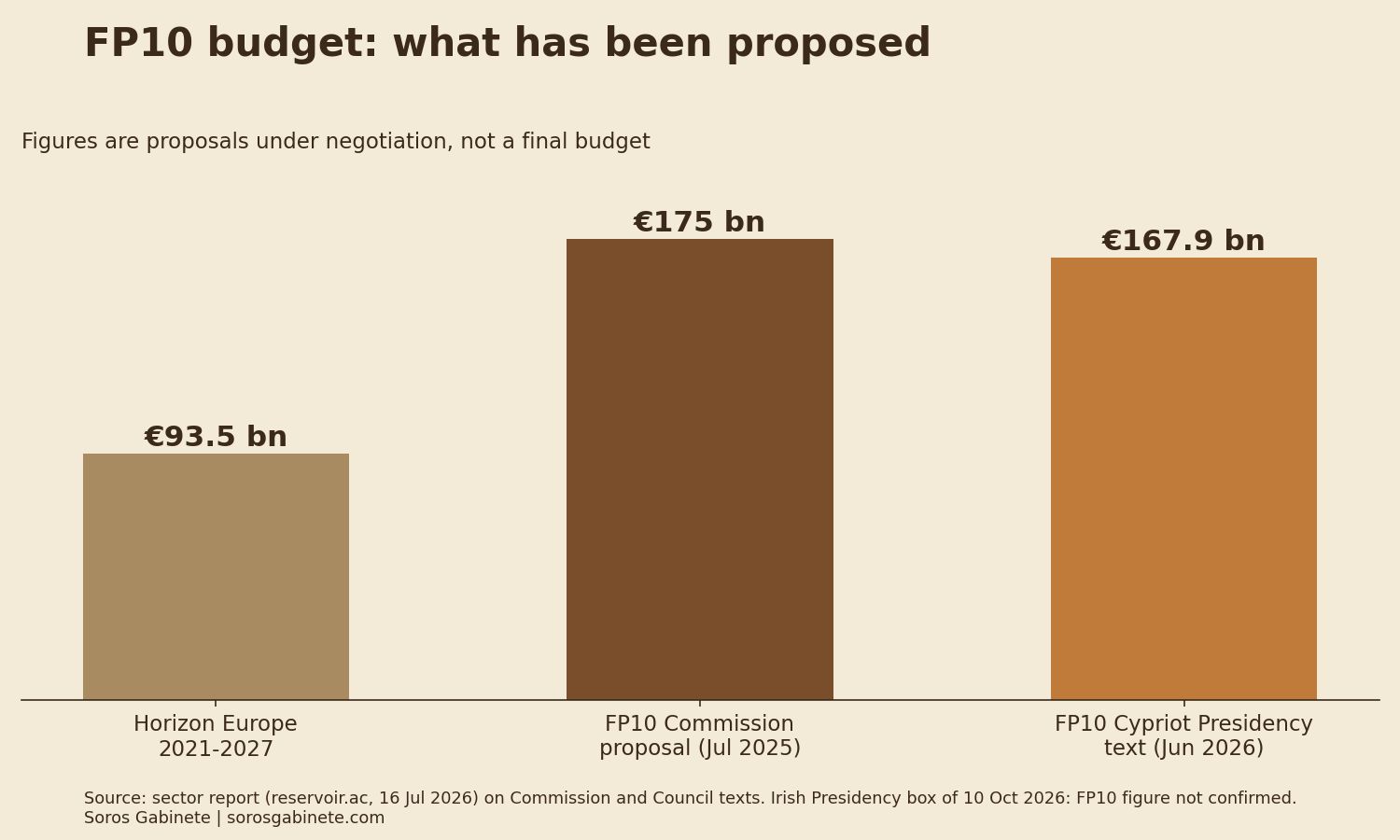
FP10 is the tenth Framework Programme for research and innovation (2028-2034), the successor to Horizon Europe.
In July 2025 the Commission proposed €175 billion for FP10, against €93.5 billion in the current programme.
In June 2026 the Cypriot Presidency tabled a text that reduced FP10 from €175 billion to about €167.9 billion, around 4%, according to a sector report.
The Irish box of 10 October cuts the overall budget by 8%. According to Euronews, the competitiveness, research and defence heading falls by 13%, to €456 billion. The Irish government says the ECF package stays above €400 billion.
The FP10 figure inside the Irish box has not been confirmed in the sources checked for this article.
EU leaders are due to discuss the box on 15-16 October. The Presidency aims for an agreement before the end of 2026. The European Parliament's lead negotiators have already rejected the proposal as a starting point.
Why public R&D funding matters
Economic research gives three reasons to fund research with public money.
Innovation drives growth. Robert Solow's 1957 study of the US economy attributed most of the growth in output per worker between 1909 and 1949 to technical change rather than to more capital or labour. Paul Romer and Philippe Aghion later explained how investment in knowledge and incentives to innovate sustain growth.
Markets under-invest. Kenneth Arrow showed that knowledge is hard to capture: others use it without paying, and research results are uncertain. A company therefore gains only part of the social value of its research and invests less than society would want. Empirical work finds that the social returns to R&D exceed the private returns.
Public money can attract private money. Well-designed public funding can lead to additional private investment that would not otherwise appear, rather than replacing it.
The EU also invests a considerably smaller share of its GDP in R&D than the United States. Cutting the budget for FP10 and the ECF would widen that gap.
For technology companies the effect is practical. Deep-tech ventures can spend years in development before they earn revenue. Collaborative projects in Pillar II and the European Innovation Council (EIC) are two of the routes that bridge that gap.
EAIC's position
In its statement EAIC, which represents innovation consultancies working with SMEs, start-ups, universities and industry, asks EU institutions and Member States to:
protect an ambitious FP10 and ECF budget;
safeguard excellence-based research;
preserve strong collaborative research under Pillar II;
keep a clear path from scientific discovery to industrial deployment and scale-up;
develop FP10 in close coordination with the ECF, with complementary roles, without losing expert assessment and excellence-based evaluation.
What companies can do now
Do not pause preparation. The 2028-2034 calls are still years away, and the final FP10 figure is open. Consortia and project ideas built now will be needed whatever the final number is.
Expect more competition if the budget falls. Success rates in oversubscribed instruments are already low. Less money for the same demand makes strong, well-built proposals more important.
Follow the split as well as the total. The division between pillars and between FP10 and the ECF will decide how much reaches collaborative projects and the EIC.
Watch the calendar. The 15-16 October leaders' discussion is the next checkpoint.
FAQ
Is FP10 being cut? Not decided. A cut is proposed for the overall EU budget, and an earlier Council text reduced FP10. Final figures need agreement among the Council, the Parliament and the Commission.
Does this affect current Horizon Europe calls? No. Open and forthcoming calls are funded under the current programme.
Who decides? Member States in the Council, with the European Parliament, which has rejected the Irish proposal as a starting point.
Sources: Irish Presidency press release (gov.ie, 10 Oct 2026); Euronews, 10 Oct 2026; European Parliament press release, 10 Oct 2026; Reservoir, 16 Jul 2026; EAIC statement (eaic.eu/news, 9 Oct 2026); Solow, "Technical Change and the Aggregate Production Function" (1957); Bloom, Schankerman and Van Reenen, Econometrica (2013); Soros Gabinete.
Need help with your funding application?
Our team of experts is ready to help you secure funding for your innovation project.
Contact Us