What Changes in the EIC's €1.8 Billion Work Programme for 2027?
The EIC will allocate €1.8 billion in 2027, with a two-stage Pathfinder, single-company Transition projects, four Accelerator cut-offs and a growing scale-up and defence track.
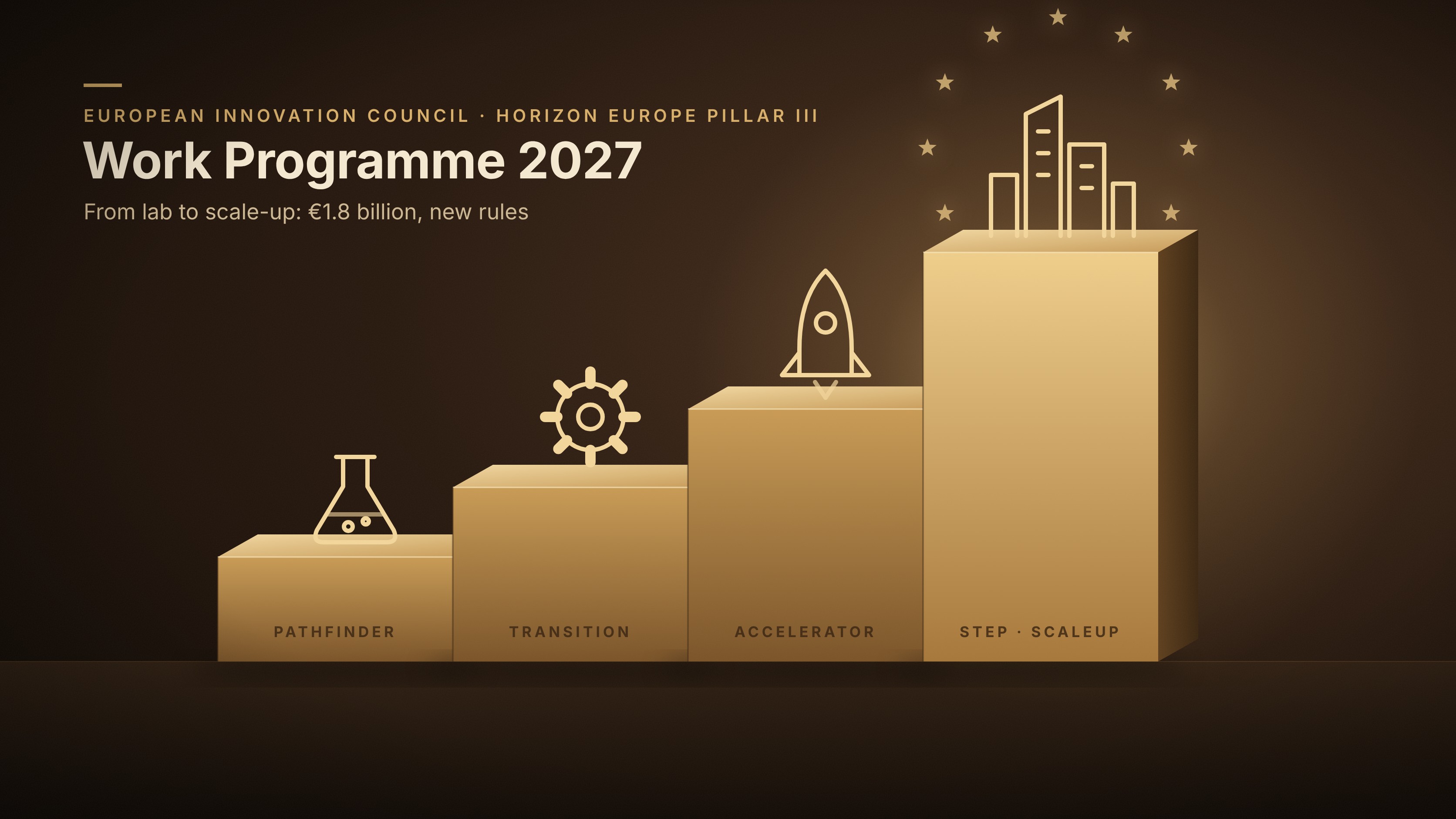
On 5 November 2026 the European Commission adopted the 2027 Work Programme of the European Innovation Council, the last one under Horizon Europe 2021–2027 [1]. The headline figure, €1.8 billion, is easy to repeat. What matters more for anyone preparing an application is where that money sits, and how the rules have moved underneath it. Read closely, the 2027 programme tells a clear story: growth sits almost entirely at the equity and scale-up end, the grant instruments get slightly smaller and stricter, and three of them change the way they select projects. 2027 is also a bridge year. The Commission has proposed turning the EIC into a standalone innovation pillar with a budget roughly 3.5 times larger in the 2028–2034 programme, which Parliament and Council are still negotiating [1][3]. What is tested in 2027 is very likely what the next EIC will look like.
Where the money goes
The table compares the main lines of the 2027 programme with the 2026 one. The comparison is more revealing than the total.
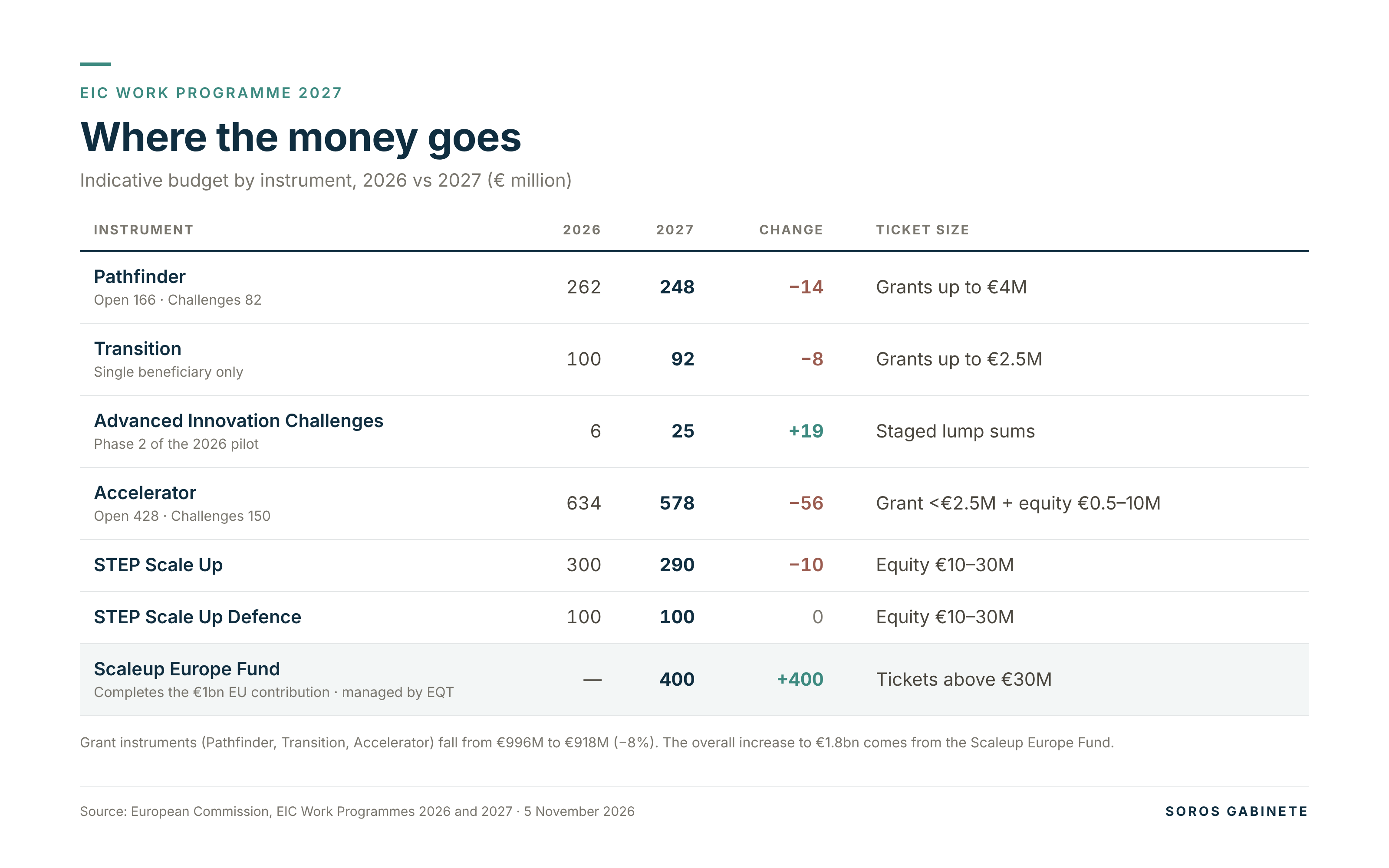
Sources: 2027 Work Programme [1][2]; 2026 figures from the 2026 Work Programme and EIC info day material [6][7].
The three grant instruments (Pathfinder, Transition and Accelerator) fall from €996 million to €918 million, about 8% less. Inside the Accelerator, the Open line actually grows slightly while the Challenges line drops by almost a third, from €220 million to €150 million. The overall increase from €1.4 billion to €1.8 billion is explained by the Scaleup Europe Fund. In other words, the probability of winning a grant does not improve in 2027; if anything, with application volumes still rising, it gets harder. The six instruments in the table add up to about €1.33 billion, and €1.73 billion with the Scaleup Europe Fund; the balance corresponds to other actions in the programme.
Pathfinder: two stages, and stage 1 does the filtering
Pathfinder Open becomes a two-stage process, with interviews for shortlisted proposals, because the scheme simply receives too many applications [1][3]. The first stage closes on 25 February 2027 and the second on 16 September 2027; the Challenges line keeps a single deadline on 29 September 2027 [2]. According to the draft programme, the stage 1 proposal is around ten pages [4].
It would be a mistake to read stage 1 as a formality. In 2026, Pathfinder Open had a success rate of around 2% [11], and the purpose of the new stage is precisely to filter at scale. A short proposal has to communicate the long-term vision, the breakthrough and the high-risk, high-gain logic in a fraction of the space, which is harder, not easier, than writing a long one. Under the 2026 rules, which the final 2027 text is expected to keep, Open still requires a consortium (at least three independent entities from three eligible countries), while single applicants and two-partner teams are only possible under some Challenges [11]. Pathfinder, together with Transition and the Advanced Innovation Challenges, remains reserved for civil applications [1][3].
Transition: single applicant only, and a customer from day one
This is the change most likely to be misread. Single applicants could already apply to Transition in 2026, alongside consortia of two to five partners [10]. What changes in 2027 is the opposite: Transition becomes single-beneficiary only and consortium applications are no longer eligible [1][4]. In addition, a letter of intent from a potential customer or user is required from stage 1 [4]. The single deadline is 14 September 2027 and the budget is €92 million [2].
The EIC Board explains the logic well: Transition is a step towards commercialisation, not a collaborative research instrument, and the single-beneficiary model brings speed, simplicity and clear accountability [3]. The practical consequences are concrete. A Pathfinder or ERC Proof of Concept consortium that wants to continue must decide which entity carries the result forward, and must have the IP and access rights arranged so that this entity can actually exploit it. A spin-off may be the natural vehicle, but it has to exist and have the rights in place before the deadline. And the letter of intent cannot be improvised in August: it requires a real conversation with a real customer or user, which takes months. In 2026, precursor projects also had to meet timing windows (an ongoing project started more than 18 months before the cut-off, or a completed one finished less than 24 months before it) [11]; these are worth checking against the final 2027 text before choosing which result to build on.
Accelerator: fewer windows, the same three-strike rule
The Accelerator keeps its logic: a short proposal that can be submitted at any time and, after a GO, a full proposal at a batching date. What changes is the number of windows, which drops from six to four: 20 January, 17 March, 1 September and 4 November 2027 [2][4]. Fewer cut-offs mean longer gaps between them, and a missed date now costs months rather than weeks. With the short proposal evaluated in four to six weeks, a company aiming at 20 January should already have its short proposal submitted.
Two rules deserve to be kept in mind. First, after three unsuccessful submissions at any stage (short proposal, full proposal or interview), a company cannot apply to the Accelerator again under Horizon Europe [9]. With only four windows and 2027 as the final year of the programme, each attempt is worth more, and submitting an immature full proposal just to fill a slot is a poor strategy. Second, under the 2026 rules a GO obtained under the 2025 or 2026 Work Programme gave access to the full-proposal stage [9]; companies holding a GO should verify how the 2027 text treats it and plan to use it within the year. The EIC Board has also asked for further streamlining, with shorter applications, faster evaluations and stronger technical due diligence [3], building on the 2026 reform that cut the full proposal to 20 pages [12]. The 4 November 2027 cut-off will be the last one under Horizon Europe; what follows depends on the negotiation of the next framework programme.
Advanced Innovation Challenges: not a new open door
The €25 million for Advanced Innovation Challenges in 2027 should not be read as a fresh call for newcomers. The pilot was launched in 2026 with feasibility projects of €300,000; it funds 20 of them, and around ten are expected to move to prototyping and demonstration in 2027, with payments tied to milestones [1][5]. The 2026 programme already planned €6 million for the first stage and €25 million for the second in 2027, with a phase 2 deadline on 18 June 2027 [6][7]. The EIC has announced a dedicated information day on 3 February 2027 [8], which is the moment to see whether anything opens beyond the current cohort. For the rest of the ecosystem, the interest of this pilot lies elsewhere: it is the EIC's first ARPA-style experiment, and the Board has said it will evaluate what worked before the next programme [3]. Its lessons, especially the role of programme managers and staged funding, are likely to shape the EIC after 2027.
Scale-up: where the EIC is putting its weight
The scale-up end is where the programme grows. STEP Scale Up keeps €290 million for equity tickets of €10 to €30 million in companies raising rounds of €50 million or more in critical technologies. The defence call adds another €100 million, bringing the dedicated defence effort to €200 million, with tickets of €10 to €30 million for areas such as air and missile defence, drones and counter-drone systems [1][3]. The Board argues for protecting the STEP budget because it addresses a funding gap of €30 to €100 million for companies developing strategic technologies [3].
The Scaleup Europe Fund completes its €1 billion EU contribution with €400 million in 2027. Three facts about it matter for founders. It is managed by EQT, which takes its own investment decisions; it aims at average tickets above €100 million and expects 30 to 40 investments in total; and companies previously backed by the EIC receive no preferential treatment [1]. The fund targets at least €4 billion more from other investors, and Denmark's EIFO has already committed €200 million, its largest equity investment ever, noting that eight out of ten European scale-up rounds are led by non-European investors [1]. The fund is therefore not an automatic next step after the Accelerator. It is a market investor that happens to have public money behind it.
Smaller changes that are worth knowing
Women TechEU is redesigned and doubles its grant from €75,000 to €150,000 per women-led start-up, and a new European Prize for Women Innovators in Quantum is created [1]. For companies already in the EIC portfolio, Business Acceleration Services add support to test their technologies with public and private buyers, including through public procurement, to help them win their first customers [1][3]. Finally, the Board supports using AI to assist the evaluation of the growing number of proposals, on condition that humans remain accountable and that confidentiality, applicants' IP, transparency and bias protection are safeguarded [3]. Whatever the final implementation, proposals that state their claims clearly and support them with evidence will read better to any evaluator, human or assisted.
What applicants should do now
The EIC holds an online information day on 2027 funding opportunities on 19 November 2026, from 09:30 to 15:40 CET; registration closes on 18 November at 09:30 CET [4]. A session on Accelerator Challenges follows on 20 November, and one on Advanced Innovation Challenges on 3 February 2027 [8].
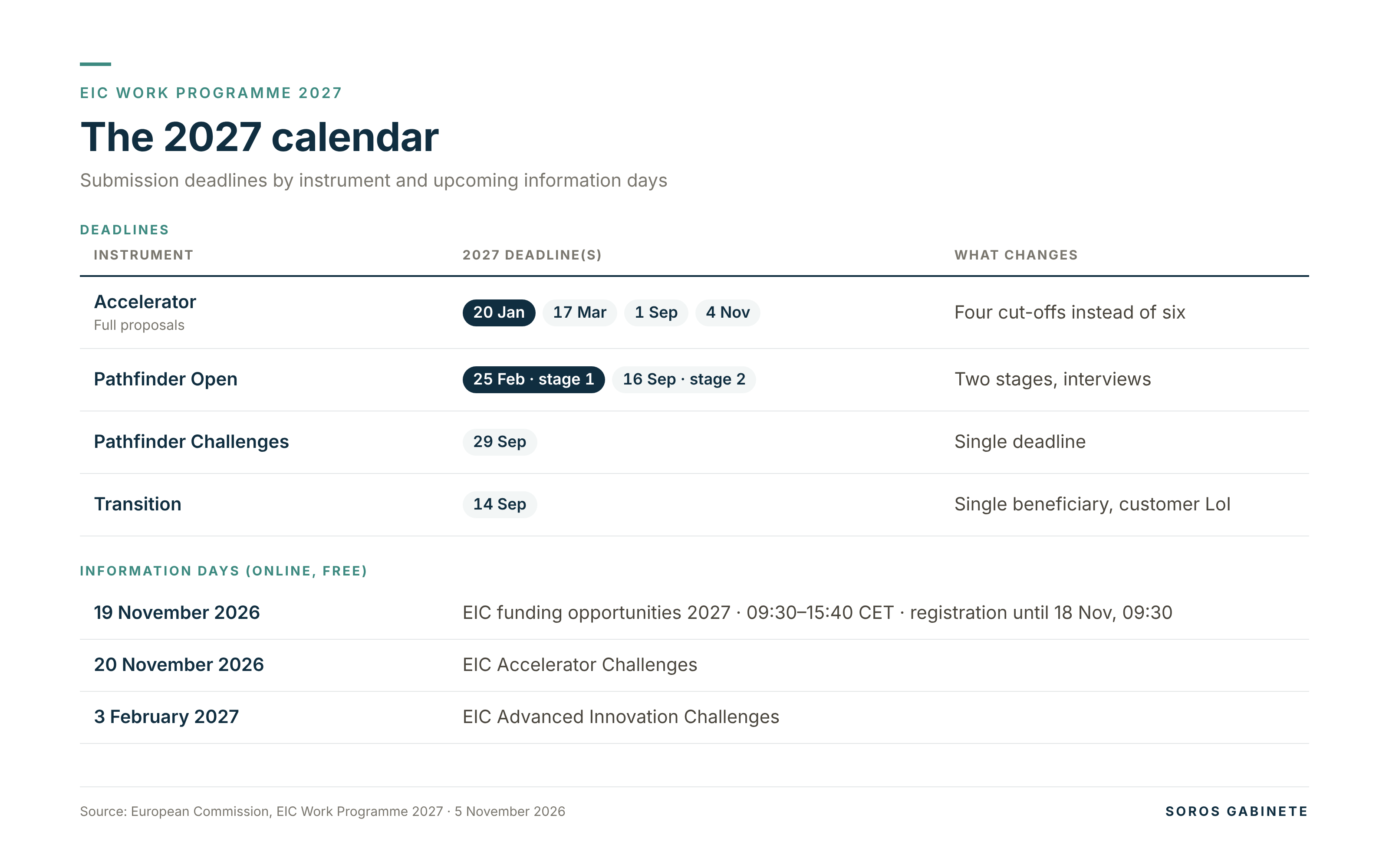
The right sequence depends on the profile. A start-up or SME with a product close to market should treat 20 January as the real deadline, which means a short proposal submitted now and a full proposal under construction in December, keeping the three-strike limit in mind. A research consortium aiming at Pathfinder Open has until 25 February, but the stage 1 text should be drafted and stress-tested by mid-January, because this is now where most proposals are eliminated. A team or company sitting on a Pathfinder, ERC Proof of Concept or Horizon Europe result should use the coming months to settle who carries the result, close the IP arrangements and secure a credible letter of intent from a customer or user ahead of the 14 September Transition deadline. And a later-stage company raising a large round should look at STEP, and at the Scaleup Europe Fund as what it is: an investor with its own criteria. In every case, 2027 is the last year under the current rules. Those who prepare in November will be the ones ready when the calendar opens.
References
[1,2] European Innovation Council, "European Innovation Council launches €1.8 billion in funding for 2027", 5 November 2026. https://eic.ec.europa.eu/news/european-innovation-council-launches-eur18-billion-funding-2027-2026-11-05_en
[3] EIC Board, "Statement on the 2027 EIC Work Programme", 2026. https://startupcafe.ro/wp-content/uploads/2026/11/EIC-Board-Statement-EIC-WP2027.pdf
[4] EUACC, "Pulse 20: EIC 2027 restructures every instrument", 2 November 2026. https://www.euacc.ai/briefing/pulse-20
[5] EUACC, "Pulse 24: 2027 EIC Work Programme adopted", November 2026. https://www.euacc.ai/knowledge/pulse/24
[6] European Innovation Council, "EIC Work Programme 2026", 2025. https://eic.ec.europa.eu/system/files/2025-11/EIC-Work-Programme-2026.pdf
[7] Innovate UK Business Connect, "Horizon Europe: EIC Info Day in the UK" (presentation), 20 November 2025. https://iuk-business-connect.org.uk/wp-content/uploads/2025/11/Final-Presentation-EIC-Info-Day-in-the-UK-20-November-2025.pdf
[8] Università della Svizzera italiana, "EIC Online information day: EIC funding opportunities in 2027", 2026. https://www.usi.ch/it/feeds/36864
[9] European Innovation Council, "FAQs: EIC Accelerator". https://eic.ec.europa.eu/eic-frequently-asked-questions/faqs-eic-accelerator_en
[10] BayFOR, "EIC Transition". https://www.bayfor.org/en/eu-funding/research-funding-programmes-for-smes/eic-transition.html
[11] EUACC, programme pages for EIC Pathfinder Open and EIC Transition, 2026. https://www.euacc.ai/programmes/pathfinder-open · https://www.euacc.ai/programmes/eic-transition
[12] European Innovation Council, "EIC Accelerator". https://eic.ec.europa.eu/eic-funding-opportunities/eic-accelerator_en
Related: EIC Accelerator 2026
Need help with your funding application?
Our team of experts is ready to help you secure funding for your innovation project.
Contact Us