EIC Accelerator 2025: Lower Volume, Tighter Filters, Higher Competitive Intensity
The consolidated data from the second 2025 cut-off of the EIC Accelerator confirms what many in the ecosystem were already sensing: the programme has entered a new phase defined by reduced volume, sharper screening, and sustained geographic concentration of success.
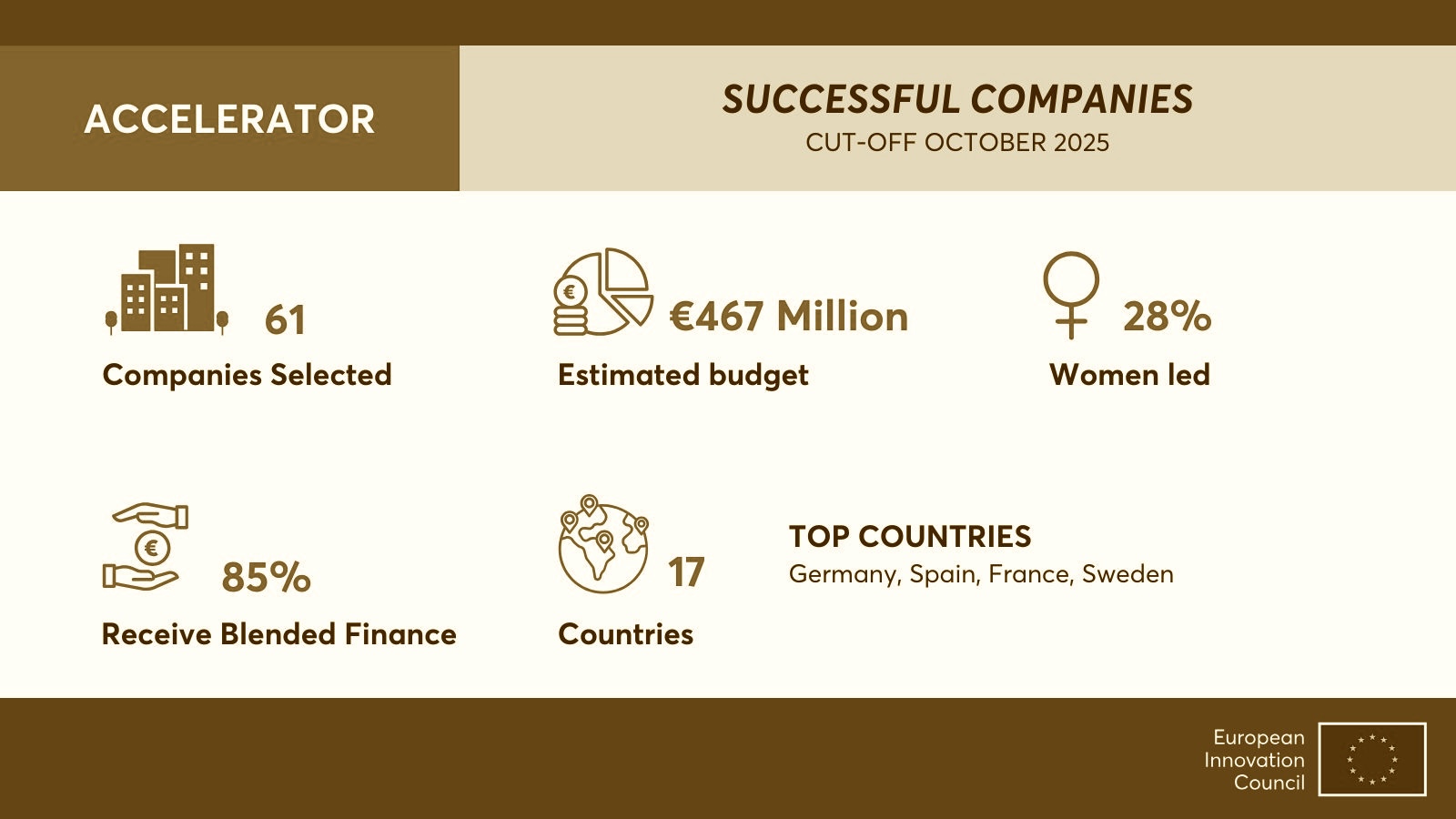
October 2025: A New Benchmark for Selectivity
In the second cut-off of the year, 923 Full Applications (FAs) were submitted. Only 121 companies were invited to the face-to-face (F2F) interviews — 13% of total FAs. In 2024, that figure stood at 36%. The contraction is substantial.
Ultimately, 61 companies were selected for funding. This translates into:
50% success rate at F2F stage
7% success rate over total FAs submitted
The structural bottleneck has clearly shifted upstream. The decisive filter is no longer the jury interview — it is the remote evaluation phase.
2025 in Context: A More Stringent Model
Looking at the full year:
FA-to-Winning success rate: 5% (below the historical cumulative average of 7%)
F2F-to-Winning success rate: 37% (a record high)
This contrast suggests a deliberate tightening at the written evaluation stage, while maintaining relatively stable conversion once companies reach the interview. Strategically, this means that narrative clarity, business case robustness, and equity positioning are more critical than ever before arriving in Brussels.
At the same time, the total number of Full Applications continues to decline. The implementation of the three-max-submissions rule is likely to reinforce this trend. The EIC Accelerator is becoming less crowded — but more professionalised.
Geography of Success: Structural Leadership Persists
In October, the 61 funded companies came from 17 countries. Germany and Spain led with 9 funded companies each, followed by France with 8. Switzerland re-entered strongly with 4 companies after re-joining Horizon Europe.
Across 2025:
Germany outperformed France for the third time since 2021
Spain achieved its best historical performance, with 14 funded companies
Sweden, the Netherlands, and the UK maintained strong results
Cumulatively, over five years (11,873 FAs submitted), the pattern remains consistent: Germany leads overall, France ranks second, and a stable core group — the Netherlands, Spain, Sweden, Israel, the UK, and Finland — consistently retains top-ten positions. Italy consolidated its place after entering the top ten for the first time in 2024.
What the Data Really Signals
The EIC Accelerator is structurally more competitive at the written stage.
The realistic probability of funding now stabilises around 5–7%.
Technological excellence alone is insufficient — strategic maturity is decisive.
Strong national ecosystems continue to capture a disproportionate share of outcomes.
In practical terms, the EIC Accelerator should no longer be treated as a traditional grant programme. It increasingly resembles a public-backed venture instrument operating with institutional-grade expectations.
And that requires playing at a different level.
Need help with your funding application?
Our team of experts is ready to help you secure funding for your innovation project.
Contact Us