What Horizon Europe reveals about the real bottleneck in European innovation
Europe is not falling behind in the global innovation race due to a lack of talent or scientific capability. It is running into a far less visible constraint: its ability to finance the innovation it is already capable of producing.
What Horizon Europe reveals about the real bottleneck in European innovation
For years, Europe has been described as lagging behind the United States or China in innovation. But the latest data from Horizon Europe (2021–2025) suggests a very different reality. Europe is not short of ideas. It is not short of scientific excellence. And it is certainly not short of ambition. What it is short of is the capacity to fund the innovation it is already generating.
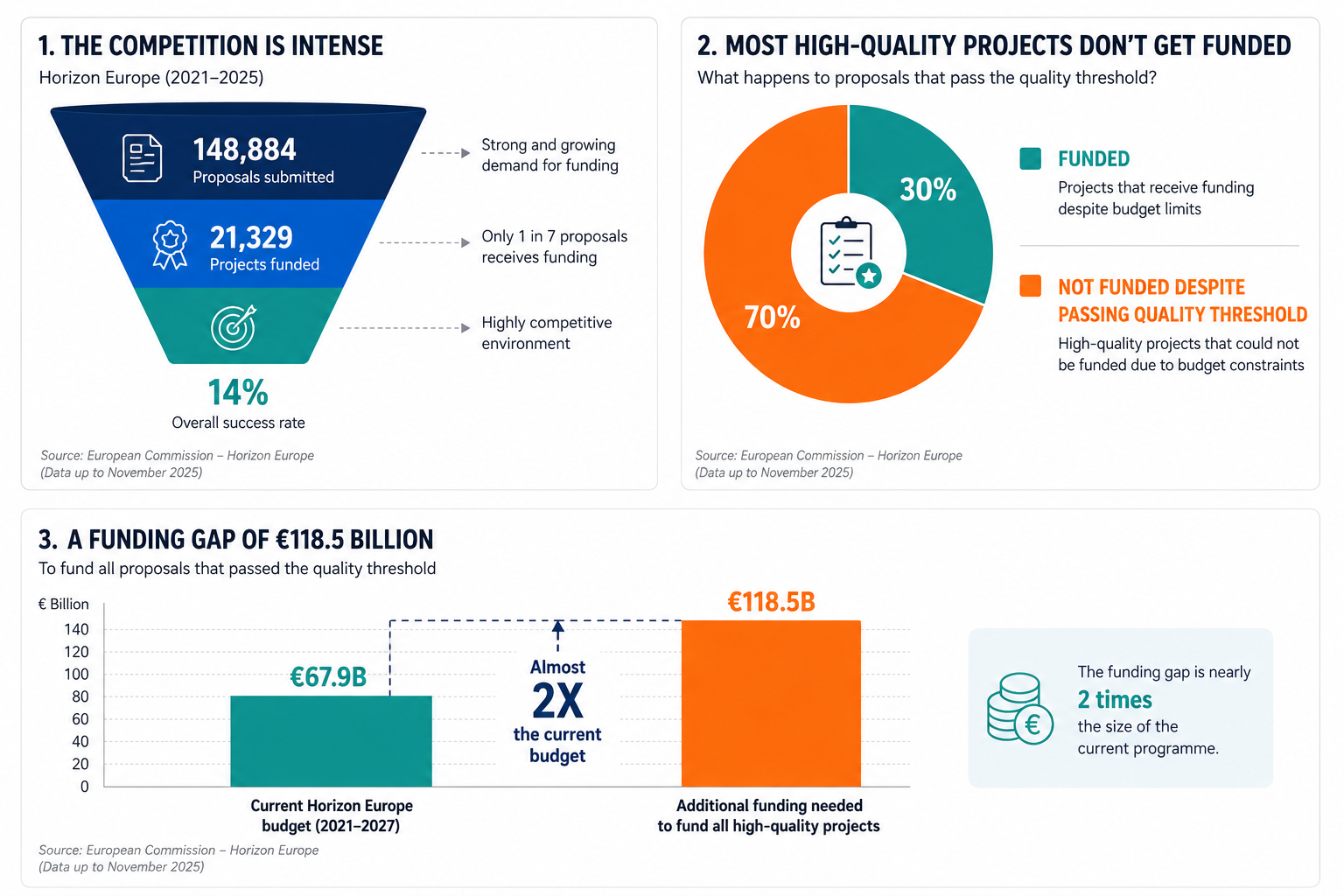
Between 2021 and 2025, Horizon Europe received 148,884 project proposals, of which 21,329 were funded, resulting in a success rate of just 14%. At first glance, this reflects a highly competitive programme. But the real story is not competition — it is saturation.
The hidden bottleneck: high-quality innovation without funding
The most revealing figure in the entire programme is not the success rate, but what happens behind it. Around 70% of proposals that met the quality threshold were not funded due to budget constraints.This changes the narrative completely. These are not weak ideas being filtered out. These are projects that passed technical and scientific evaluation, but still could not be financed.
In other words, Europe is not rejecting innovation because it lacks quality — it is rejecting it because it lacks budget capacity. The scale of this mismatch becomes even clearer when translated into funding needs: to support all high-quality proposals, Horizon Europe would have required an additional €118.5 billion, almost double the current programme budget of €67.9 billion. This is no longer a marginal funding gap. It is a structural imbalance between demand and available resources.
A system under strategic pressure, not failure
This does not mean the system is broken. On the contrary, Horizon Europe is one of the most sophisticated public R&D funding frameworks in the world. But it is operating under increasing pressure.
The EU is concentrating its innovation strategy around a set of clear priorities: artificial intelligence, quantum technologies, biotechnology, clean energy, advanced manufacturing, and dual-use technologies linked to security and defence.
These are not just thematic choices, they reflect a geopolitical shift in how Europe sees innovation: less as a support function for research, and more as a core instrument of economic competitiveness and strategic autonomy. At the same time, the system is becoming more selective. In a context of limited resources, funding decisions are no longer just about quality. They are about alignment, timing, scalability, and strategic fit.
What this means for innovators in Europe
For companies, startups, and research organisations, this shift has a direct implication: excellence is necessary, but no longer sufficient. Success in European funding is increasingly determined by how well projects align with strategic priorities, how effectively they are structured across consortia, and how clearly they demonstrate impact beyond the research itself.
As competition intensifies, small differences in proposal quality or positioning can have large effects on funding probability. In practice, Europe is moving toward a system where the best-prepared actors do not just win more often, they win disproportionately.
Europe’s real constraint is not ideas, but absorption capacity
The Horizon Europe data points to a simple but powerful conclusion. Europe is producing more high-quality innovation than it can currently absorb. The challenge is no longer primarily about generating ideas or stimulating research activity. It is about scaling the financial and institutional capacity needed to turn those ideas into reality.
Because in today’s Europe, the limiting factor is not innovation supply. It is innovation funding capacity.
Need help with your funding application?
Our team of experts is ready to help you secure funding for your innovation project.
Contact Us